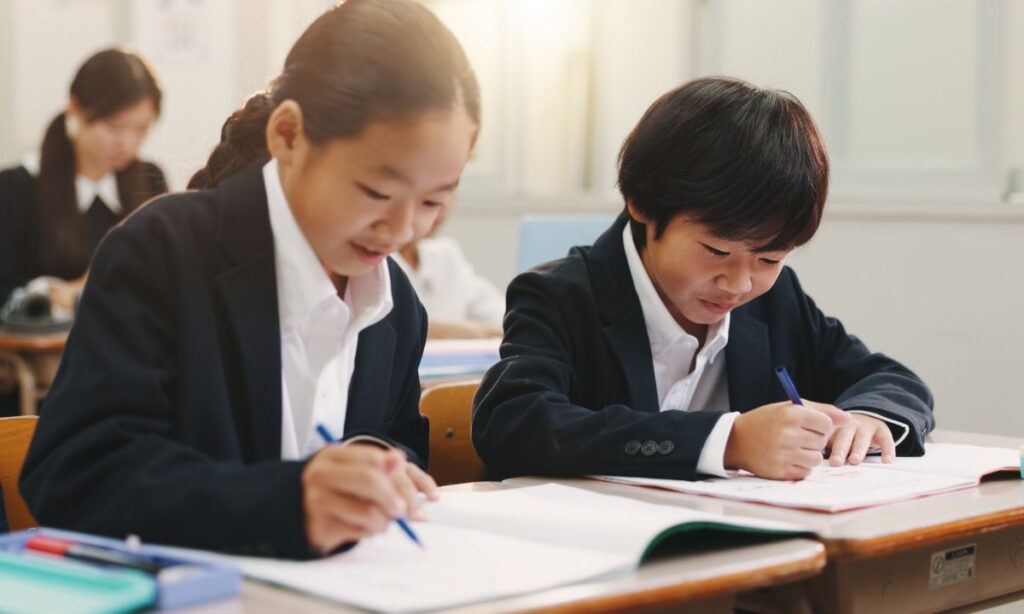


Cambridge A2 Key Camp in Hua Hin
Part 7 of the A2 Key for Schools Reading and Writing paper is the task that M3 students most consistently underestimate, under-prepare for, and underperform on in the examination. The task asks students to write a short story of at least thirty-five words based on three picture prompts. It carries fifteen marks — the same as Part 6 — and together the two writing tasks carry thirty percent of the total reading and writing paper marks. For a task worth this much, the preparation most students bring to it is disproportionately thin: they know they need to write a story, they know it should be more than thirty-five words, and they know it should use past tense. What they typically do not know is how to construct a narrative from three images, how to connect events with the linking words that examiners reward, or how irregular past simple verbs behave in the kinds of sentences that picture stories require.
The Cambridge A2 Key camp in Hua Hin for M3 students addresses this directly. The morning sessions dedicated to Writing Part 7 use Cambridge’s official picture story lesson plan — an approach that begins with analysing a sample text against explicit success criteria, then practises past simple verbs through a matching game, then asks students to plan and write their own story within a structured time frame.
The Success Criteria That Most Students Have Never Been Taught
Cambridge’s lesson plan for A2 Key for Schools Writing Part 7 builds its instruction around a set of success criteria that students analyse before they write. A good Part 7 answer uses past tense verbs throughout. It uses conjunctions to show connections between events — and, but, because, so. It uses time linkers — first, then, after, when, later — to show the sequence of the three pictures. It covers all three pictures, not just the first one. And it is creative — there are many possible stories from any three pictures, and examiners respond positively to answers that are genuinely inventive rather than mechanically descriptive.
M3 students at the Cambridge A2 Key camp in Hua Hin work through these criteria explicitly in morning sessions, using a sample text as the reference point. The native teacher guides the class through the analysis — how many words does this story have, which verbs are regular and which are irregular, where are the conjunctions, which linking words connect the three pictures — in a class of twelve where every student participates in the analysis and every student writes their own story for the group to respond to.
Past Simple Regular and Irregular Verbs — the Grammar the Story Requires
The most common writing errors in A2 Key for Schools Part 7 are verb errors — students who write go instead of went, buyed instead of bought, or who mix past and present tense within the same story. Cambridge’s lesson plan for this task includes a specific stage in which students play a matching game with regular and irregular past simple verbs before writing, building the verb accuracy that the story requires before the creative task demands it.
In the Cambridge A2 Key camp in Hua Hin, the native teacher delivers this stage as a competitive group activity in the class of twelve — students race to match infinitives to past simple forms, which makes the grammar genuinely engaging and ensures that the verb forms are active in students’ memory when they start to write.
The Afternoon: Plearn Wan Vintage Village
Plearn Wan vintage village is the afternoon destination that connects most directly to Writing Part 7, because the setting is itself a story. The vintage village is designed around early twentieth century Thai commercial life — small wooden shophouses, traditional food stalls, and an atmosphere of a specific historical moment — and the native teacher uses the visit to generate the narrative raw material that students will use in a picture story writing session the following morning.
Students walk through the village, observe, describe, and discuss in English — and the native teacher asks them to imagine what happened here on a particular day, to invent characters who lived and worked in these buildings, and to begin forming the narrative instincts that A2 Key for Schools Part 7 specifically rewards. The Cambridge A2 Key camp in Hua Hin connects this afternoon experience to the following morning’s writing session, so that the picture story students write is informed by the real narrative thinking the village visit generated.
ILC Hua Hin provides 24/7 supervision for all residential and off-site elements of the programme. Full safeguarding and welfare details are available for school directors before any booking is confirmed. The British Council’s guidance for young learners and Cambridge’s preparation resources provide useful context for schools and parents.
Use the ILC Hua Hin English level test before booking to confirm your M3 students are at the right level.
Find out more about the Residential English Speaking Camp at ILC Hua Hin and how the Cambridge A2 Key camp in Hua Hin develops writing skills. Speak to our team to discuss dates, duration, and what the writing programme would deliver for your M3 group.