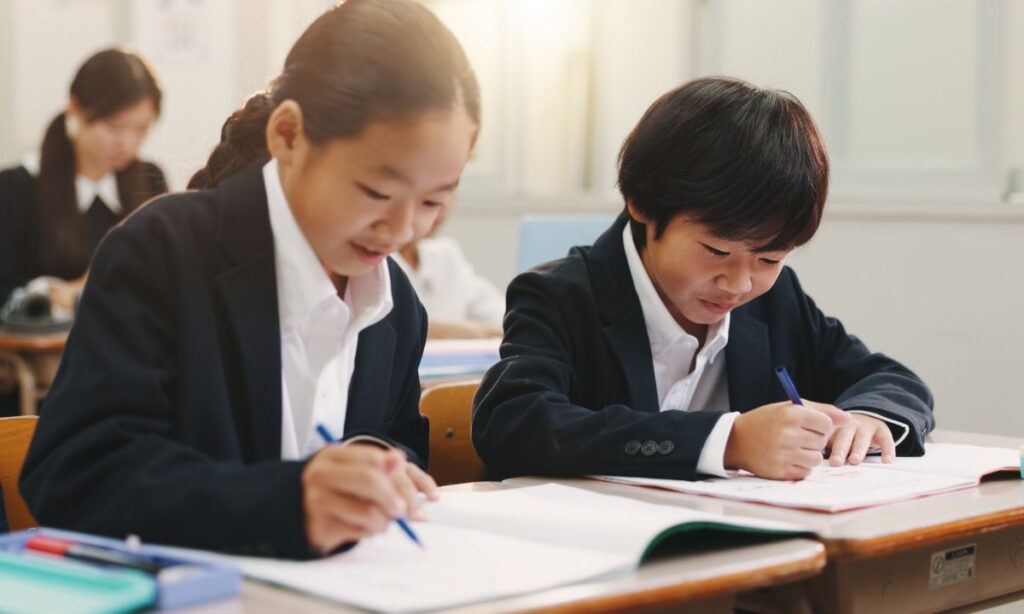


A Trinity GESE School Trip in Hua Hin
The Trinity GESE Grade 4 examination requires every candidate to prepare a personal topic — something they genuinely know, have real opinions about, and can discuss for several minutes with a trained examiner who will ask follow-up questions they have not prepared for. In most classroom preparation settings, students reach for safe, generic topics: my school, my family, my favourite sport. These topics are predictable, and Trinity examiners hear them hundreds of times. What the assessment genuinely rewards is a candidate who has something specific to say, who speaks with natural confidence because the topic belongs to them, and who can answer an unprepared question without losing composure because they were actually there.
A Trinity GESE school trip in Hua Hin changes what the prepared topic can be. Students who spend their afternoons at landmarks across Hua Hin and Prachuap Khiri Khan province — the 1926 railway station, Khao Takiab’s coastal temple hill, Maruekhathayawan Palace above the sea, the Hutsadin Elephant Foundation — arrive at their Trinity GESE examination with a topic built on genuine personal experience in a genuinely interesting place. When the examiner asks a follow-up question about the elephant sanctuary, the student who was there the day before yesterday answers differently from the student who found their topic in a textbook. Trinity examiners are trained to hear that difference, and the assessment rewards it.
English in the Morning, Hua Hin in the Afternoon
The structure of a Trinity GESE school trip in Hua Hin at ILC is straightforward. Three hours every morning with a native English teacher in a class of no more than twelve students develops the specific communicative skills the examination assesses — extended responses, linked turns, the ability to give reasons and respond to unprepared questions without switching to a memorised script. The afternoon takes students out into Hua Hin and Prachuap Khiri Khan province, where those same skills find real application in places that are genuinely interesting and genuinely varied.
This is not a school trip with some English lessons bolted on. The school trip and the English programme are the same thing. The railway station visit is a speaking lesson in which the vocabulary is architecture, history, and descriptive language. The elephant foundation is a speaking lesson in which the vocabulary is conservation, wildlife, and personal response. The morning builds the communicative tools. The afternoon gives students something real to use them on — and something real to talk about in the examination room afterwards.
What the Examination Actually Involves
Grade 4 communicative skills and language requirements have been mapped to CEFR level A2.2, and from Grade 4 onwards candidates must prepare a personal topic for discussion during the exam. The examination is a ten-minute one-to-one conversation with a trained Trinity examiner. It covers the prepared personal topic and two subject areas the examiner selects from a standard list. There is no reading paper, no writing task, no multiple choice. The entire assessment is spoken — which means the most effective preparation for it is exactly what a residential school trip in Hua Hin provides: three hours of daily speaking practice with a native teacher, in a class small enough that every student speaks, receives feedback, and speaks again. Cambridge English
GESE qualifications are designed to develop communicative skills and build confidence, and complement general English language courses. For M4 students whose English has been built through classroom study but limited real speaking practice, this is the qualification that rewards what the residential school trip develops. chula
Tailoring the Trip to Your Budget
Schools can choose the length of stay that suits their budget and their academic calendar. A three-day Trinity GESE school trip in Hua Hin covers the core morning skills and two afternoon visits, giving students enough preparation for the examination and enough of Hua Hin to build a genuinely personal topic. A five-day or full week stay delivers the complete programme — all afternoon destinations, a mock examination on the penultimate morning, and the full compounding effect of residential immersion. ILC Hua Hin works with every school to find the right duration.
ILC Hua Hin provides 24/7 supervision across all residential and off-site elements of the programme — qualified staff on-site throughout, secure accommodation, and a structured daily timetable from morning to lights-out. Full welfare and safeguarding details are available before any booking is confirmed.
Find out more about Hua Hin as a destination and the wider Prachuap Khiri Khan province before you book.
Visit the ILC Trinity GESE page for full details of how the programme is structured, or speak to our team to discuss dates, group size, and the length of stay that works for your school’s budget.