


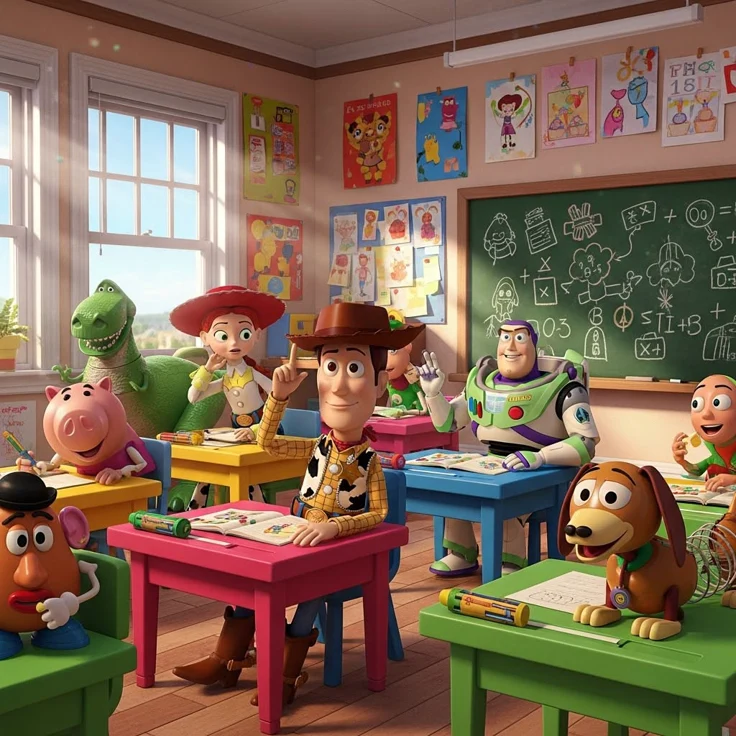
How Toy Story and Sharing Ideas in English Work
Woody has an opinion about everything. He knows exactly what he thinks, he knows why he thinks it, and he is not shy about telling you. Buzz Lightyear, on the other hand, arrives with absolute certainty about who he is and what he is for — and spends most of the film discovering that the world is more complicated than his confidence suggested. Between them, Toy Story and sharing ideas in English create one of the most naturally productive teaching combinations available for children aged six to eight.
The reason Toy Story works so well in a speaking programme is that it is fundamentally a film about perspective. Two characters who see the same situation completely differently. A group of toys with conflicting loyalties and competing interests. A child — Andy — whose feelings matter but who we rarely hear from directly. Every scene is rich with opportunities to ask: what do you think about this? Whose side are you on? What would you have done?
Those questions are the engine of a session built around Toy Story and sharing ideas in English.
Why Woody and Buzz Create Natural Debate
Ask a group of six-year-olds whether Woody was right to try to get rid of Buzz and you will not get silence. You will get an argument. Some children will feel strongly that Woody was wrong and say so clearly. Others will understand why Woody felt threatened and want to defend him. A few will want to talk about what they would have done if they were in that situation.
That disagreement — that genuine difference of opinion — is exactly what Toy Story and sharing ideas in English are designed to produce. When children disagree about something they care about, they use language purposefully. They search for the words they need. They build more complex sentences than they would in a neutral exercise. They listen more carefully to the other person because they are trying to respond to what was actually said.
Voice 21 identifies the ability to share, defend, and revise ideas through spoken language as one of the core components of oracy. Toy Story gives children something worth arguing about, which is the most direct route to that skill.
The Ensemble Cast and What It Offers
One of the practical advantages of Toy Story and sharing ideas in English as a teaching resource is the size and variety of the cast. Rex the anxious dinosaur. Hamm the sarcastic piggy bank. Slinky the loyal dog. Bo Peep. The Little Green Men. Each character has a distinct personality and a distinct way of communicating.
In a Disney English Club session, children can be assigned a character and asked to speak from that character’s perspective. Rex might need to be encouraged — what does Rex say when he is nervous? Hamm might need to be challenged — do you agree with Hamm, or do you think he is being unfair? This kind of character-based speaking activity develops vocabulary, sentence structure, and the ability to take on and express a point of view.
The British Council’s young learner guidance consistently identifies role play and perspective-taking as among the most effective activities for building spoken language confidence in children at this age. The cast of Toy Story makes both possible within a single session.
Sharing Ideas Beyond the Story
Toy Story and sharing ideas in English also work well as a springboard for conversations that move beyond the film itself. Once children are comfortable talking about what Woody and Buzz think, it becomes natural to ask them what they think. Do you have a favourite toy? What would your toys say about you if they could talk? What is the most important thing a friend can do?
These questions draw children out of the story world and into their own experience — which is where the most authentic and complex language tends to come from. A child who can describe their own relationship with a favourite toy, in English, to a group of seven other children, is doing something genuinely impressive. And they rarely notice how impressive it is because they are too busy enjoying the conversation.
You can find out more about how Disney stories are used throughout the programme on the Disney English Club page and on the English Explorers page.
What the Research Says About Story-Based Speaking
Research on storytelling and language acquisition is consistent in showing that narrative-based speaking activities produce richer, more varied language output than task-based exercises disconnected from a story context. Children reach for more precise vocabulary, use longer sentences, and demonstrate more sophisticated turn-taking when they are talking about characters and events they are emotionally connected to.
Toy Story and sharing ideas in English sit at the intersection of all of those findings. The film provides the emotional connection. The characters provide the perspective. The classroom provides the speaking opportunity. Cambridge Assessment English research on young learner task design shows that this combination — emotional investment plus genuine communicative purpose — is among the most effective approaches available for this age group.
To find out more about Disney English Club and secure a place for your child, visit the ILC Hua Hin page or complete the pre-application form.