
M2 English Camp
There is a moment that happens on almost every M2 English camp in Hua Hin — usually around the second afternoon, when students are somewhere genuinely interesting and the native teacher asks a question that nobody prepared for. A student who barely spoke on the first morning produces three sentences. Then four. Then a follow-up thought that nobody prompted. The teacher responds naturally, asks what they meant by something, and the student explains. It lasts about ninety seconds, and it is worth more than a month of classroom drills. This is what the M2 English camp in Hua Hin is built to produce — not rehearsed answers to anticipated questions, but real spoken English in response to a real world, with a real native speaker who is genuinely listening.
The programme runs for three hours every morning with a maximum of twelve students per class, following the A2 Key for Schools framework. The afternoon takes students out into Hua Hin. The two halves of the day are designed to reinforce each other — the vocabulary and speaking structures of the morning appearing again in the afternoon’s real communicative contexts, and the experiences of the afternoon feeding back into the following morning’s formal work.
What the A2 Key for Schools Programme Develops at M2 Level
The A2 Key for Schools qualification is specifically designed for school-aged learners who have moved past the foundational Young Learners assessments and are ready to communicate across a broader range of topics with greater grammatical sophistication. For M2 students in Thailand, it represents the level at which English becomes a genuinely productive skill rather than a school subject — the point at which they can hold a real conversation, write a short message with purpose, understand a recording about an everyday situation, and read a simple text and comprehend it rather than just decode it.
The topics the qualification covers are those that secondary students actually think about — travel, the environment, food, sport, relationships, school, and the world around them. The grammar is the grammar of real communication — past tenses for narrating what happened, comparatives for describing and evaluating, modals for discussing possibility and preference, and question forms for genuine interactive exchange. The M2 English camp in Hua Hin develops all of these through speaking tasks that require students to produce this language actively, in interaction with a native teacher who responds to what they say rather than what they were supposed to say.
The Three Hours That Change the Day
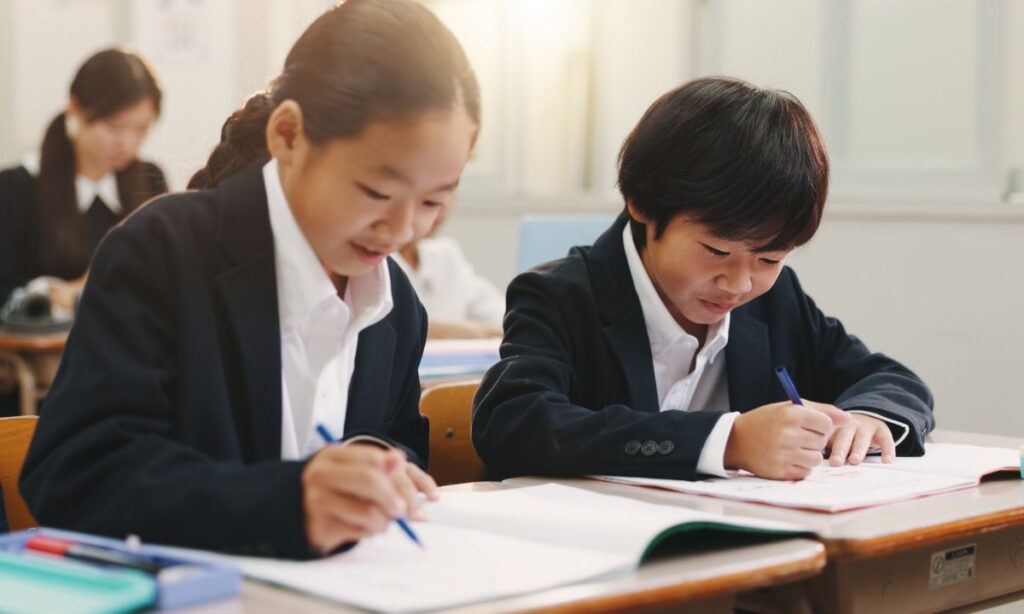
Three hours of morning instruction with a native English teacher and a maximum of twelve students is a different proposition from what most M2 students experience in their regular school English class. In a class of twelve, there is nowhere to hide and no reason to. Every student speaks every session. The native teacher knows each student’s name, knows their specific errors, knows which grammatical structure they are struggling with and which one they have just cracked, and can adjust every interaction accordingly.
The A2 Key for Schools preparation framework covers reading, writing, listening, and speaking — but the residential camp at ILC Hua Hin concentrates on speaking specifically, because speaking is the skill the M2 English camp in Hua Hin is most uniquely positioned to develop. Reading and writing can be practised independently. Listening can be developed through exposure. But speaking requires a real interlocutor — someone who listens, responds, asks follow-up questions, and communicates with the natural authenticity of a native speaker. That is what the morning sessions provide, and three hours of it each day is enough to produce genuine, measurable progress across even a short residential stay.
The Afternoon: Khao Takiab
The afternoon visit to Khao Takiab — the coastal temple hill at the southern end of Hua Hin known widely as Monkey Mountain — generates a specific kind of spoken English that no classroom activity produces. The environment is genuinely surprising and genuinely beautiful. There are real monkeys, a real sea view from the summit, and a real temple that prompts the kind of spontaneous descriptive and evaluative language that the A2 Key for Schools speaking tasks specifically require.
Students describe what they see, compare the landscape to places they know, discuss what they think of the monkeys, and engage in the kind of natural, extended conversation with the native teacher that the M2 English camp in Hua Hin uses as its most powerful learning tool. The environment vocabulary from the morning session — habitat, wildlife, climate, landscape — finds real-world application on the hill in a way that makes it far more memorable than any vocabulary exercise could achieve. By the time students return for the evening programme, they have used A2 Key vocabulary in a context that was genuinely theirs — a conversation they actually had, about something they actually saw.
ILC Hua Hin provides 24/7 supervision across all residential and off-site elements of the M2 English camp in Hua Hin, including the afternoon cultural excursions. The British Council’s framework for young learner English provides useful context for school directors communicating the programme’s quality to parents.
Use the ILC Hua Hin English level test to confirm your M2 group is at the right level before booking.
Explore the Residential English Speaking Camp for full programme details, or look at the Residential English Tours as a broader option. Speak to our team to discuss what the M2 English camp in Hua Hin delivers for your school group.