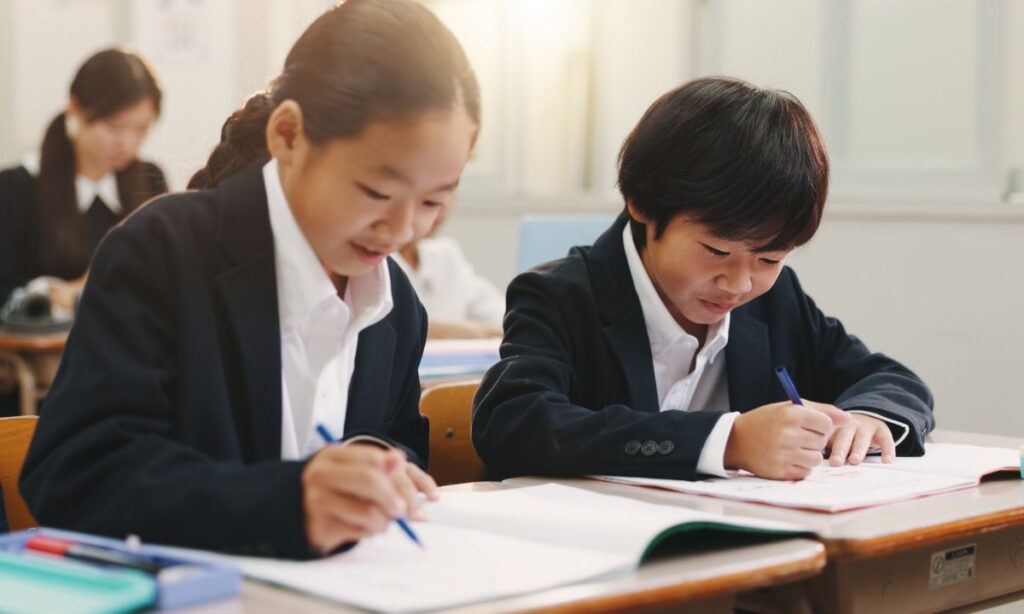


M2 English Speaking Programme in 2026
Late afternoon at the Cicada Market in Hua Hin, a group of M2 students from a Thai secondary school are navigating a real market in English. One student is asking a vendor about the price of something. Another is describing a piece of artwork to the native teacher beside her. A third is attempting to explain to a classmate — in English, because that is the rule — why he thinks a particular street food looks alarming. None of this was scripted. All of it is A2 Key for Schools language in genuine use. And all of it was made possible by three hours of morning instruction with a class of twelve and a native teacher who spent the morning building exactly the vocabulary and communicative confidence these students are now applying in a Hua Hin night market.
This is what an M2 English speaking programme in Thailand looks like when it is working. Not students reciting answers to anticipated questions, but students using English because the situation requires it, because they have the tools to do so, and because a week in Hua Hin has given them enough practice and enough confidence to try.
What the A2 Key for Schools Framework Gives M2 Students
The A2 Key for Schools qualification develops English across all four skills at CEFR A2 level, but it is most distinctive in the speaking tasks it requires. Students must describe photographs, interact with a partner in a discussion about an everyday topic, and respond to personal questions from the examiner in extended, independently produced English. These are not tasks that reward memorised scripts — they reward the communicative confidence and linguistic flexibility that genuine speaking practice develops.
An M2 English speaking programme in Thailand built on this framework gives students exactly the preparation these tasks require. Three hours of native teacher instruction each morning in a class of no more than twelve means that every speaking task in a session generates real individual feedback — from a teacher who can hear what each student is actually producing and respond to it with the precision and naturalness of a native speaker. This level of attention is structurally impossible in a larger class, and it is what makes the small group format central to the programme’s effectiveness rather than merely a selling point.
The Vocabulary and Grammar That the Programme Builds
The A2 Key for Schools vocabulary framework covers topics that M2 students actually think and talk about — travel and transport, the environment, food and eating, sport and leisure, school and friends, technology in everyday life, and the world beyond their immediate experience. The grammar targets — past simple, past continuous, comparatives, modals, and question formation — are the structures that secondary school English immediately calls on and that M2 students most consistently need to develop beyond the foundational level their primary education has established.
At ILC Hua Hin’s M2 English speaking programme in Thailand, all of this is developed through communication rather than through exercises. The native teacher designs sessions around speaking tasks that naturally require these structures — narrative tasks that call on past tenses, description tasks that use comparatives, discussion tasks that involve modals. Students develop grammatical accuracy through use, which is how it sticks, rather than through rules memorised in isolation, which is how it does not.
The Afternoon: Cicada Market
The Cicada Market visit is one of the most communicatively rich activities in the afternoon programme. The market — open on Friday, Saturday, and Sunday evenings — is a genuine Hua Hin institution, full of local art, crafts, food, and the kind of relaxed, exploratory atmosphere that lowers students’ communicative guard and raises their willingness to attempt English in real situations.
The native teacher accompanies the group throughout the visit, engaging students in conversation about what they see, what they like, what they want to buy, and what they think of what they are experiencing. The transactional English of the market — asking for things, enquiring about prices, expressing preferences — sits directly within the A2 Key for Schools vocabulary framework and gives the M2 English speaking programme in Thailand its most authentic communicative context of the day. Students use the language because they need it, and the need produces the kind of motivated, spontaneous English that no classroom simulation can replicate.
The vocabulary for food and shopping that the morning session developed now has real stakes — a student who cannot remember the English for what they want to ask will miss something, and that motivation sharpens the communicative effort in a way that a practice exercise simply does not.
ILC Hua Hin provides 24/7 supervision across all elements of the residential programme, including all off-site visits. The A2 Key for Schools preparation resources from Cambridge provide the academic framework that structures the morning sessions. The British Council’s guidance for young learner English provides useful context for communicating the programme’s educational basis to parents and school management.
Use the ILC Hua Hin English level test before booking to confirm your M2 students are at the right level for the A2 Key for Schools framework.
Explore the Residential English Speaking Camp at ILC Hua Hin for full programme details. Speak to our team to discuss what the M2 English speaking programme in Thailand would look like for your school and how to fit it within your academic calendar.